Digital Logic Design
Digital Logic Design: Where Software Stops and Hardware Begins
Programming Fundamentals and Database Systems both deal with logic that lives entirely inside software, but Digital Logic Design pulled me one level deeper, into the hardware that actually makes any of that software run in the first place. It was strange, in a good way, to spend a lab session reasoning about voltage levels and gate behavior after spending another lab session that same week writing Python conditionals two subjects that felt completely different on the surface but turned out to rely on the exact same underlying idea of true and false.
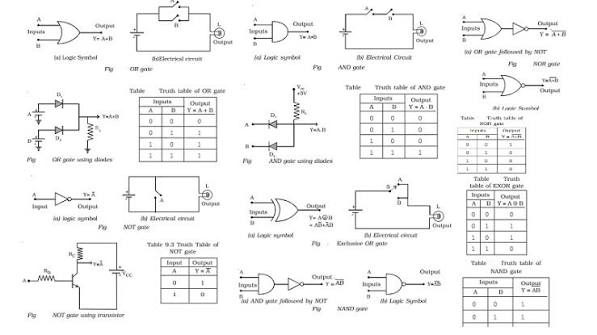
The course started with the basic logic gates AND, OR, NOT, NAND, NOR and at first they felt almost too simple to take seriously. It did not take long to realize that simplicity was the entire point. Every one of these gates does exactly one small, predictable thing, and the real skill in digital logic design is combining a handful of these simple, predictable things into something that can make a meaningful decision. That idea echoed something I had already been learning in Programming Fundamentals about conditional logic, except here the “if” and “else” were physically built out of transistors instead of written as keywords.
We used Microwind software throughout the semester to design and simulate circuits, which made the subject far less abstract than it would have been on paper alone. Being able to change an input and immediately watch the output respond turned static diagrams into something closer to an experiment. One expression I worked with repeatedly during lab sessions was a combined condition involving multiple gates at once:
1
Output = (A AND B) OR (NOT C)
Working through an expression like this in Microwind meant testing every possible combination of A, B, and C and confirming the output matched what the boolean algebra predicted on paper. The first few times, my simulated output did not match my hand-written truth table, and tracking down why usually a gate wired to the wrong input, or a sign flipped somewhere in my logic turned into the same kind of careful, line-by-line debugging I had already been doing in Python, just expressed as wires and gates instead of code.
As the semester progressed, we moved from individual gates into small combinational circuits, where multiple gates work together to perform a more complex decision in a single step. Designing these circuits required thinking several steps ahead in a way that felt different from programming. In software, you can always add another line, run the program again, and see the result almost instantly. In digital logic, every additional gate adds real complexity to the circuit, and a design that looks elegant on paper can become a tangled mess of wires if it is not planned carefully before being built in simulation.
What stuck with me most from this course is how directly it explained something I had taken for granted my entire life: that a computer, underneath every app and every line of code, is ultimately just an enormous number of these simple logic gates arranged in patterns complex enough to add numbers, store memory, and execute instructions. Knowing that a Python “if” statement and a physical AND gate are, at their core, expressing the same underlying logic gave me a much more complete picture of what a computer actually is, rather than treating software and hardware as two unrelated worlds.
By the end of the semester, looking at a logic gate diagram no longer felt like reading an unfamiliar language. I could trace through a combination of gates, predict the output for a given set of inputs, and understand why a particular design choice made the circuit more efficient or more reliable. That ability to move between the abstract world of code and the physical world of circuits, even at a beginner level, is something I did not expect to value as much as I now do, and it has made me genuinely more curious about the hardware side of Computer Engineering going forward.
Karnaugh maps were one of the more frustrating but ultimately rewarding tools introduced partway through the course. The idea of simplifying a boolean expression by grouping adjacent ones in a grid felt almost like a puzzle game the first few times I tried it, and I distinctly remember the satisfaction of reducing a messy expression with five or six terms down to something with two or three, simply by recognizing patterns in the grid correctly. Getting it wrong usually meant grouping cells that were not actually adjacent in the way the technique requires, and catching that mistake taught me to be more careful about the underlying rules rather than just pattern-matching shapes on a grid.
Building a small combinational circuit that combined several simplified expressions into a single working design in Microwind made the value of that simplification step very concrete. A circuit built directly from the original, unsimplified expression used noticeably more gates than the version built from the Karnaugh-map-reduced expression, even though both produced identical truth tables. Watching that difference play out in an actual simulated circuit, rather than just as numbers on paper, made the abstract idea of “efficiency” in circuit design feel real for the first time.
Sequential logic, introduced briefly toward the end of the semester, added a genuinely new dimension to everything learned earlier. Up to that point, every circuit I had built produced an output that depended only on its current inputs. Flip-flops and basic memory elements introduced the idea of a circuit that depends on its own past state as well, which took a noticeably different kind of thinking to follow. Tracing through a simple flip-flop’s behavior across several clock cycles, watching its stored value persist even as inputs changed around it, gave me a small but genuine glimpse of how a computer’s memory works at the most fundamental hardware level a world away from the Python variables I had been thinking in for most of the semester, yet built from the exact same basic gates I had already learned.
Comparing this course to Programming Fundamentals running in parallel, the biggest difference I noticed was the cost of mistakes. A bug in Python could usually be fixed by editing a line and running the program again within seconds. A poorly planned circuit in Microwind, especially one with several interconnected gates, often required redesigning a meaningful portion of the layout rather than a single small fix. That difference taught me to plan more carefully before building in digital logic than I had gotten used to doing in software, where quick iteration sometimes lets careless planning slide without much consequence.
One moment that stands out clearly from this course was the first time I had to simplify a boolean expression before building it, rather than just implementing whatever expression I had originally written down. My first version of a circuit worked correctly in simulation, but it used far more gates than necessary, and a classmate pointed out that the same logic could be achieved with half the components using basic boolean algebra rules. Redoing the circuit with the simplified expression and watching it produce identical output with noticeably fewer gates was a small but satisfying lesson in efficiency — correctness alone was not the only goal; an unnecessarily complicated design that happens to work is still a worse design than a simpler one that works just as well.
I also started noticing parallels between debugging a circuit in Microwind and debugging a program in Python, even though the two subjects felt completely separate at the start of the semester. In both cases, the actual debugging process was the same: isolate the smallest piece of the system that is misbehaving, test it on its own with known inputs, and only then trust the larger system built on top of it. Realizing that the same underlying discipline applies whether you are tracing wires or tracing variable values made Digital Logic Design feel less like an isolated hardware course and more like another expression of the same problem-solving habits I was building everywhere else this semester.